Southern Ocean Mechanics
The Eddy Saturation Problem
Yanni Bills (Advised by Dr. Elizabeth Yankovsky)
May 10, 2026
Intellectual Merit
The Antarctic Circumpolar Current (ACC) has a distinct character within the realm of oceanic circulation. Its average transport ranges between 100 and 150 Sverdrups, making it the strongest ocean current on Earth. It flows unobstructed around the globe, to the east, as an uninterrupted, zonally re-entrant pathway enabled by the absence of continental barriers at southern latitudes. Such a deportment is akin to atmospheric jet streams; indeed, such a current’s existence in the ocean is endowed with interconnectedness worthy of its distinguished nature.
Due to the ACC’s form and structure, it connects all ocean basins, strongly influencing global circulation and climate [7]. Westerly winds over the Southern Ocean drive a northward Ekman transport in the surface layer, which must be balanced by an upwelling of circumpolar deep water (CDW) from below. This upwelling steepens isopycnals, and the resulting geostrophic adjustment along these tilted layers helps sustain the ACC’s strong eastward flow in the subsurface. Since CDW is typically \(1-2^{\circ} \mathrm{C}\) above the local in-situ freezing point, its intrusion into sub-ice-shelf cavities provides the chemical potential gradient needed to melt ice shelf bases. In contrast, Antarctic bottom water (AABW) forms when sea ice production on the continental shelf induces brine rejection, increasing the salinity and density of the remaining water. This dense water then flows over the shelfbreak, mixes with CDW, and sinks to occupy the abyss, thereby playing a crucial role in regulating the stratification of the Southern Ocean. Informally, the interplay between CDW and AABW helps set the slope of the isopycnals, which is fundamentally linked to the strength of the ACC [4].
The Southern Ocean’s current system maintains global-scale importance. The traditional physical theory by which the Atlantic meridional overturning circulation (AMOC) runs is that of diapycnal mixing through small scale turbulent motion in the tropics [3], [6]. However, it has since been argued that the amount of lower-latitude deepwater upwelling attributed to turbulent mixing is insufficient to sustain the volumetric transport of the AMOC. Namely, an alternative wind-driven mechanism has since been proposed such that the majority of the deep-water upwelling necessary to run the AMOC occurs in the Southern Ocean as a direct byproduct of the ACC itself [8]. It is natural, then, to conceive that the strength of the ACC possesses great importance both locally and globally.
Another topic of recent interest regarding the Southern Ocean is the phenomenon of eddy saturation, in which changes in wind stress have little impact on the time-mean volume of zonal transport [5]. Furthermore, the going theory and numerical results tend to indicate a greater capability of the baroclinic mechanism, as opposed to the barotropic one, in setting these eddy-saturated states [7], [4]. But, contrarian arguments have since been made in support of the notion that the barotropic mechanism is similarly capable of setting the eddy-saturated state. We note that the barotropic mechanism refers to the depth-independent part of the flow while the baroclinic mechanism refers to the vertically sheared parts of the flow in which isobars and isopycnals tend not to align. Constantinou and Hogg [1] find zonal transport sensitivity agreement between barotropic and baroclinic runs in the more realistic wind stress magnitude regimes, thus suggesting that bathymetry plays an integral role in shaping the standing eddy flow. This argument challenges the status quo of baroclinic instability being the dominant mechanism by which eddy saturation is maintained in the ACC. However, a persistent variable that goes unaccounted for is the manner in which wind stress is treated for these idealized runs. There is a distinct lack of investigations that delineate these eddy-saturated-state regimes by dependence upon how wind stress profiles are prescribed. Idealization often entails such simplifications, but to extrapolate these model results to inform predictions in reality is an endeavor that requires a more data-informed approach to treating the mechanical forcings applied at the surface.
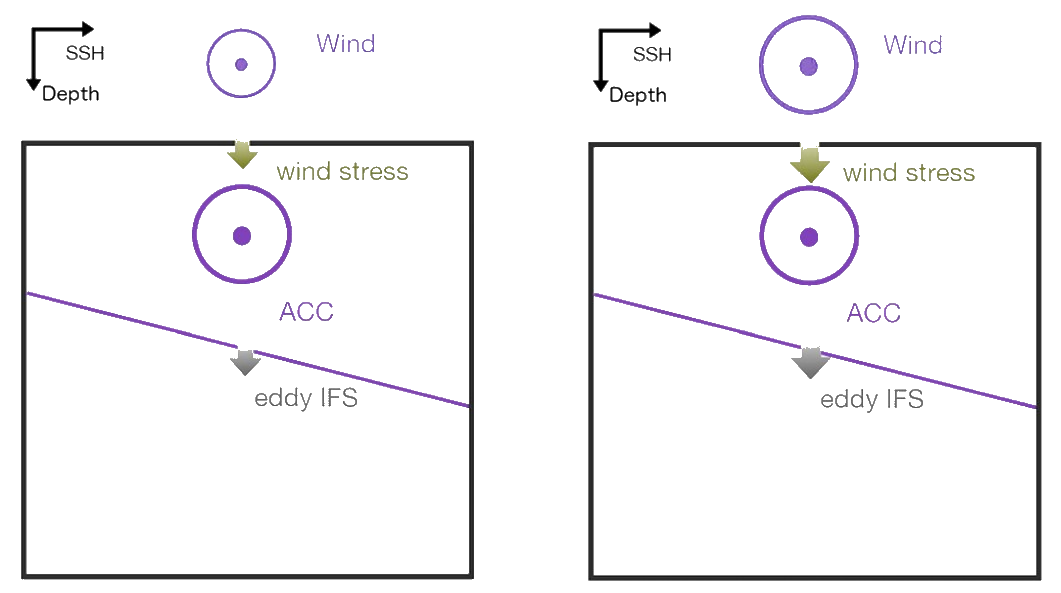
Statistical and spectral analyses of the more global picture for zonal wind forcings have been done (see [2]), but it remains to employ a more focused analysis of Southern Ocean winds to the end of better prescribing mechanical wind stress forcings for zonally re-entrant channel models. In this work, we analyze 80 years of hourly wind stress data from the Copernicus ERA5 data set. In converting \(10 \mathrm{~m}\, u\)-wind velocity values to surface wind stresses, \(\tau\) in \(\mathrm{N}\, \mathrm{m}^{-2}\), we can determine what yearly averaged wind stress profiles look like, assigning a smooth function as a fitted zonal stress profile. We also perform empirical orthogonal function (EOF) analysis to determine temporal variability on all available scales. Following this analysis, we pursue idealized runs of a model solving the canonical Boussinesq momentum and other primitive equations across a zonally re-entrant channel, only forced by surface wind stress (as in [1]). In addition to the wind stress treatment used by Constantinou and Hogg, we explore treatments that keep lateral shear fixed as intensity grows, profiles that reflect the smoothly-fitted shape of the Southern Ocean wind data, and those which vary in space and time as a reflection of general climate trends.
References
[1] N. C. Constantinou and A. McC. Hogg. “Eddy Saturation of the Southern Ocean: A Baroclinic Versus Barotropic Perspective”. In: Geophysical Research Letters 46.21 (2019), pp. 12202-12212. DOI: 10.1029/2019GL084117.
[2] S. T. Gille. “Statistical Characterization of Zonal and Meridional Ocean Wind Stress”. In: Journal of Atmospheric and Oceanic Technology 22 (2005), pp. 1353-1372. DOI: 10.1175/JTECH1789.1.
[3] H. Jeffreys. “On fluid motions produced by differences of temperature and humidity”. In: Quarterly Journal of the Royal Meteorological Society 51 (1925), pp. 347-356. DOI: 10.1002/qj.49705121604.
[4] D. P. Marshall et al. “Eddy saturation and frictional control of the Antarctic Circumpolar Current”. In: Geophysical Research Letters 44.1 (2017), pp. 286-292. DOI: 10.1002/2016GL071702.
[5] D. R. Munday, H. L. Johnson, and D. P. Marshall. “Eddy Saturation of Equilibrated Circumpolar Currents”. In: Journal of Physical Oceanography 43.3 (2013), pp. 507-532. DOI: 10.1175/JPO-D-12-095.1.
[6] Walter H. Munk. “Abyssal recipes”. In: Deep-Sea Research 13 (1966), pp. 707-730. DOI: 10. 1016/0011-7471(66)90602-4.
[7] A. L. Stewart, N. K. Neumann, and A. Solodoch. ““Eddy” Saturation of the Antarctic Circumpolar Current by Standing Waves”. In: Journal of Physical Oceanography 53 (2023), pp. 1161-1181. DOI: 10.1175/JPO-D-220154.1.
[8] J. R. Toggweiler and B. Samuels. “Effect of Drake Passage on the global thermohaline circulation”. In: Deep-Sea Research Part I: Oceanographic Research Papers 42.4 (1995), pp. 477-500. DOI: 10.1016/0967-0637(95)00012U.