Classical Scaling
Asymptotic Derivation
Consider a convective cell of vertical length scale \(L\) with top and bottom thermal BLs of thickness \(\delta_{T}\). The schematic below showcases the temperature profile under this arrangement:
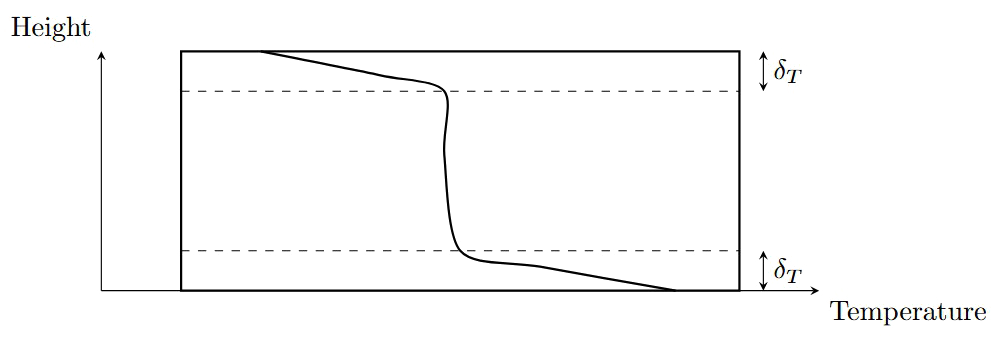
By definition of RBC’s formulation, one must note that vertical heat flux is the same at any horizontal slab in the cell. Thus, as one considers that almost all temperature drop off occurs in the thermal BLs, one can compute Nu as
This arises because the thermal boundary layers are assumed to be conductive under Malkus’ marginal stability theory. This eliminates the convective heat transport term, \(\left\langle\overline{w^{\prime} \theta}\right\rangle\), while also turning the conductive term into that proportional to half the temperature difference, \(\Delta T / 2\), with respect to the vanishingly thin boundary layer thickness. As a result, it is seen that \(\mathrm{Nu} \propto L / \delta_{T}\). It follows to consider a local Rayleigh number, \(\mathrm{Ra}_{\delta}\), at the vertical edge of the lower thermal BL as
Under marginal stability, \(\mathrm{Ra}_{\delta}\) is of order \(\mathrm{Ra}_{c}\), which is a constant. This occurs since any departures from that critical value would either cause the BL to swell or go turbulent. Both of those scenarios contradict the physical argument at play. Thus, by substitution through intrinsic fluid constants, one has that
As a result, one has that
for \(\mathrm{Ra} \gg \mathrm{Ra}_{c}\).