Convection
The Problem
Yanni Bills
May 10, 2026
Intellectual Merit
Any attempt to describe the natural environment and its pertinence to climate must consider the effects of convection. The ubiquity of convection is made self evident by its manifestation in a range of things from household appliances to large-scale atmospheric, oceanic, inner-Earth, magnetospheric, and stellar circulation. The most sophisticated models of convection, including direct numerical simulations of the full equations of motion, still lack a unifying theory for heat transport. Namely, non-rotating convection in which a fluid is heated from below and cooled from above lacks a clear asymptotic picture for how heat transfer scales with a vertical temperature gradient. For innately more complex natural systems that build upon this basic form of systematically studied convection, the assumptions and idealizations made to circumvent the computational expense of direct numerical simulations (DNS) remain incomplete. Indeed the most cutting edge models suffer not only from a lack of unifying theory for basic turbulent convection, but also from the fact that the high-dimensional flow fields make model outputs difficult to interpret.
Background
At the turn of the \(20^{\text {th }}\) century, Henri Bénard observed the formation of convection cells in a thin layer of fluid (spermaceti, or whale oil) that was heated from below. Although the patterns observed on the free surface are influenced by surface tension, now called the Marangoni effect, Bénard’s surname would eventually be joined with Lord Rayleigh’s after the latter’s 1916 work mathematically formalizing what is aptly-named Rayleigh-Bénard convection. RBC became the first and oldest systematic study of convection, remaining an active field of study.
Convection is most axiomatically described as the bulk transport of a continuum actualized by a spatial gradient. This gradient can be thermodynamic or compositional, possibly leading to the formation of a LSC. The most pedestrian example of convection is that of a boiling pot of water. A negative temperature gradient in the vertical is administered, endowing the water with a LSC referred to in layman’s terms as a “rolling boil.” RBC entails the simplest of mathematical explanations of this phenomenon, for it is a Navier-Stokes flow between parallel, isothermal plates that are generally warmer below and cooler above.
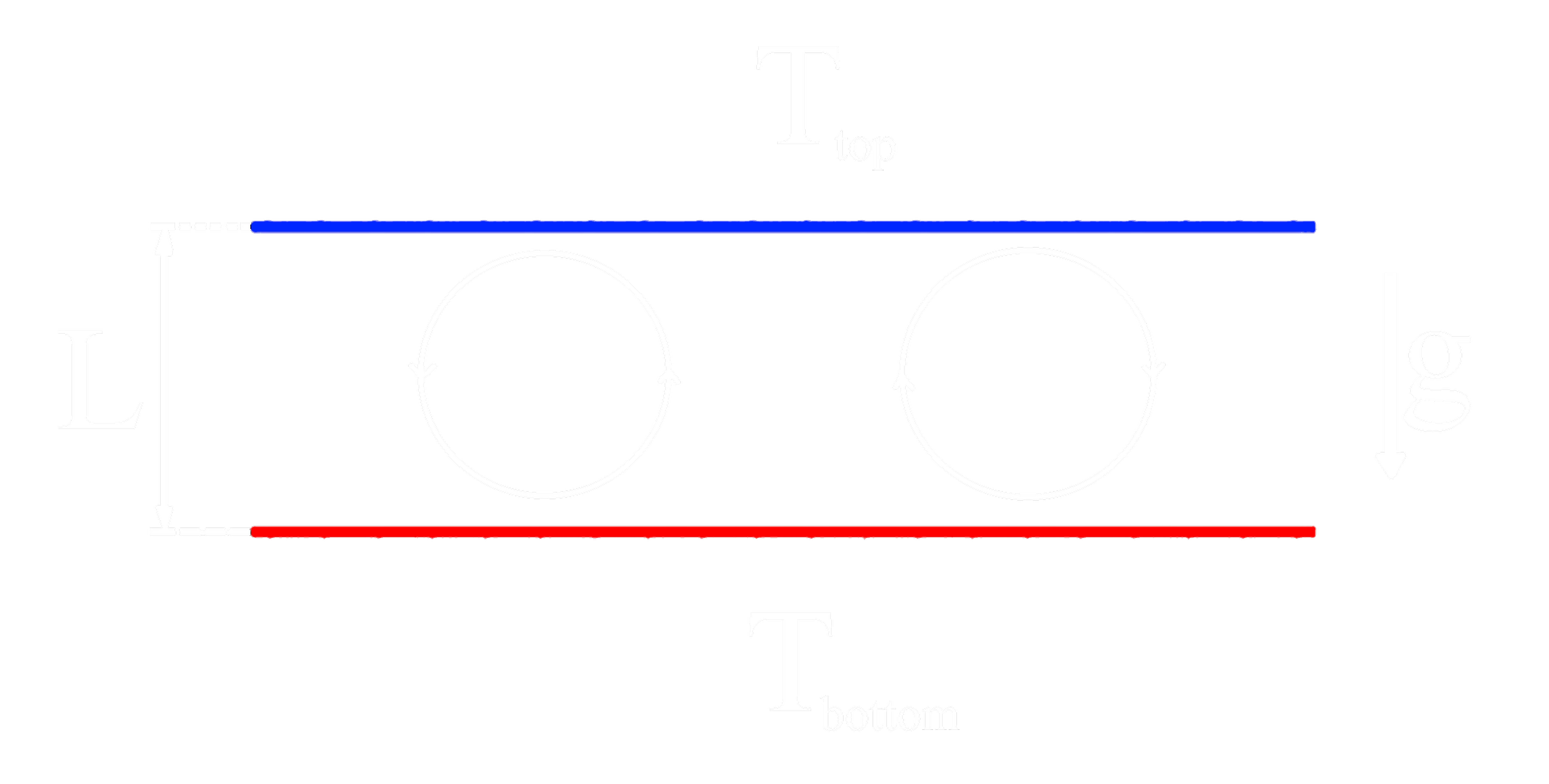
The non-rotating OB equations, serving as the beating heart of systematic convection studies, are given by
where \(\mathbf{u}=(u, v, w)\) is the flow velocity, \(T\) is temperature, \(\rho\) is density, \(p\) is pressure, \(T_{0}\) is a reference temperature, \(\rho_{0}\) is a reference density, \(\nu\) is the fluid’s kinematic viscosity in units of \(\mathrm{m}^{2} \mathrm{~s}^{-1}, \alpha\) is a thermal expansion coefficient in units of \(\mathrm{K}^{-1}, \kappa\) is the fluid’s thermal diffusivity in units of \(\mathrm{m}^{2} \mathrm{~s}^{-1}\), and \(g\) is the acceleration due to gravity. A free-fall scaling for turbulent, buoyancy-driven flows in which \(\mathbf{u} \sim \sqrt{g \alpha \Delta T L}\) and \(T \sim \Delta T\) produces the dimensionless parameters
where \(L\) is the vertical length scale of the flow and \(\Delta T\) is the temperature difference between the parallel plates. The former is the Prandtl number, describing the ratio of viscous effects to thermal dissipation effects, and is an intrinsic quantity of the fluid. The latter is the Rayleigh number; it encodes the regime of convective intensity of the flow and is a control parameter that is often treated as an independent variable for RBC experiments. A linear stability analysis using normal mode solutions for the vertical velocity component is usable to derive the necessary conditions for a positive disturbance growth rate, and, by extension, a dimensionless threshold indicating the onset of convective instability. This quantity, referred to as the critical Rayleigh number, is given by \(\mathrm{Ra}_{c}=\frac{27 \pi^{4}}{4}\).
Of principal concern in the pursuit of better understanding RBC, and convection, is heat transport. The efforts to systematize and quantify this notion began with Wilhelm Nusselt’s “Der Wärmeübergang in Rohrleitungen” in 1909 [12] and “Das Grundgesetz des Wärmeüberganges” in 1915 [11]. The relevant quantity is the Nusselt number, Nu , which is the ratio of actual heat transfer to a purely conductive reference. In RBC, this is given by the ratio of total vertical heat flux to purely conductive vertical heat flux,
Here, \(k\) is a thermal conductivity constant in units of \(\mathrm{kg}\, \mathrm{m} \,\mathrm{s}^{-3} \mathrm{~K}^{-1}, c_{p}\) is the specific heat capacity at constant pressure in units of \(\mathrm{J} \, \mathrm{kg}^{-1} \mathrm{~K}^{-1}\), and temperature is decomposed into conductive and convective parts as \(T=T_{\text {cond }}(z)+\theta(x, y, z, t)\). Overlines represent time averages and angle brackets are spatial averages. With dimensionless heat transfer quantified, it is of interest to relate Nu to \(\mathrm{Ra}, \mathrm{Pr}\), and the cell’s aspect ratio, \(\Gamma\), in the form of a power law:
In 1954, Charles Priestley ascertained that in thermal convection, the vertical heat flux is independent of the vertical length scale [13]. Independently, in the same year of 1954, Willem Van Rensselaer Malkus predicted the same regime, while also arguing that the associated power law is uniform in \(\operatorname{Pr}\) [9]. Following the initial developments, Louis Howard made a compelling marginal-stability argument in 1964, which argued that the thermal boundary layers (BLs) experience a Rayleigh number around \(\mathrm{Ra}_{c}\) [6]. These foundational physical arguments culminate in a power law exponent of \(\gamma=1 / 3\), forming the “classical” regime interpretation. In RBC, conductive thermal BLs are stipulated to persist at the parallel plate boundaries. For the \(\mathrm{Ra} \gg \mathrm{R} \mathrm{a}_{c}\) limit, these thermal BLs are assumed to become very small while possessing almost all of the vertical temperature drop-off in the cell. The classical regime’s core tenet is that these BLs control and bottle-neck the vertical heat flux.
In 1962, motivated by Priestley and Malkus’ pioneering works, Robert Kraichnan published a theory for asymptotic Nusselt-Rayleigh scaling [8], later referred to as the “ultimate” regime [3]. The physical argument entailed an eventual flow independence of boundary-locked molecular diffusion by shear effects, ushering in a turbulent eddydominated cell with enhanced vertical heat transfer. Edward Spiegel, Kraichnan’s postdoctoral associate at the time, supported the “ultimate” regime interpretation but in a different manner, neglecting the boundary layers altogether and assuming thermal plumes control flux rates independent of their origin [14]. Although this work was published a year after that of Kraichnan, in 1961 Batchelor put forth a testimony suggesting Spiegel had envisioned this argument before Kraichnan [1]. The resultant Kraichnan-Spiegel theory is conducive to enhanced vertical heat transport with a power law exponent of \(\gamma=1 / 2\). The formation of camp “ultimate” regime serves as the origin of recurrent debates regarding the two physical theories.
See the asymptotic scaling derivations:
Since the 1960s, myriad experiments, both physical and numerical, have been performed for the sake of determining the true power law exponent for asymptotic Nusselt-Rayleigh scaling. In the year 2000, Niemela et al. published results of a physical convection experiment that explored vertical heat transport effects over Rayleigh numbers in the range of \(10^{6}\) to \(10^{17}\) [10]:
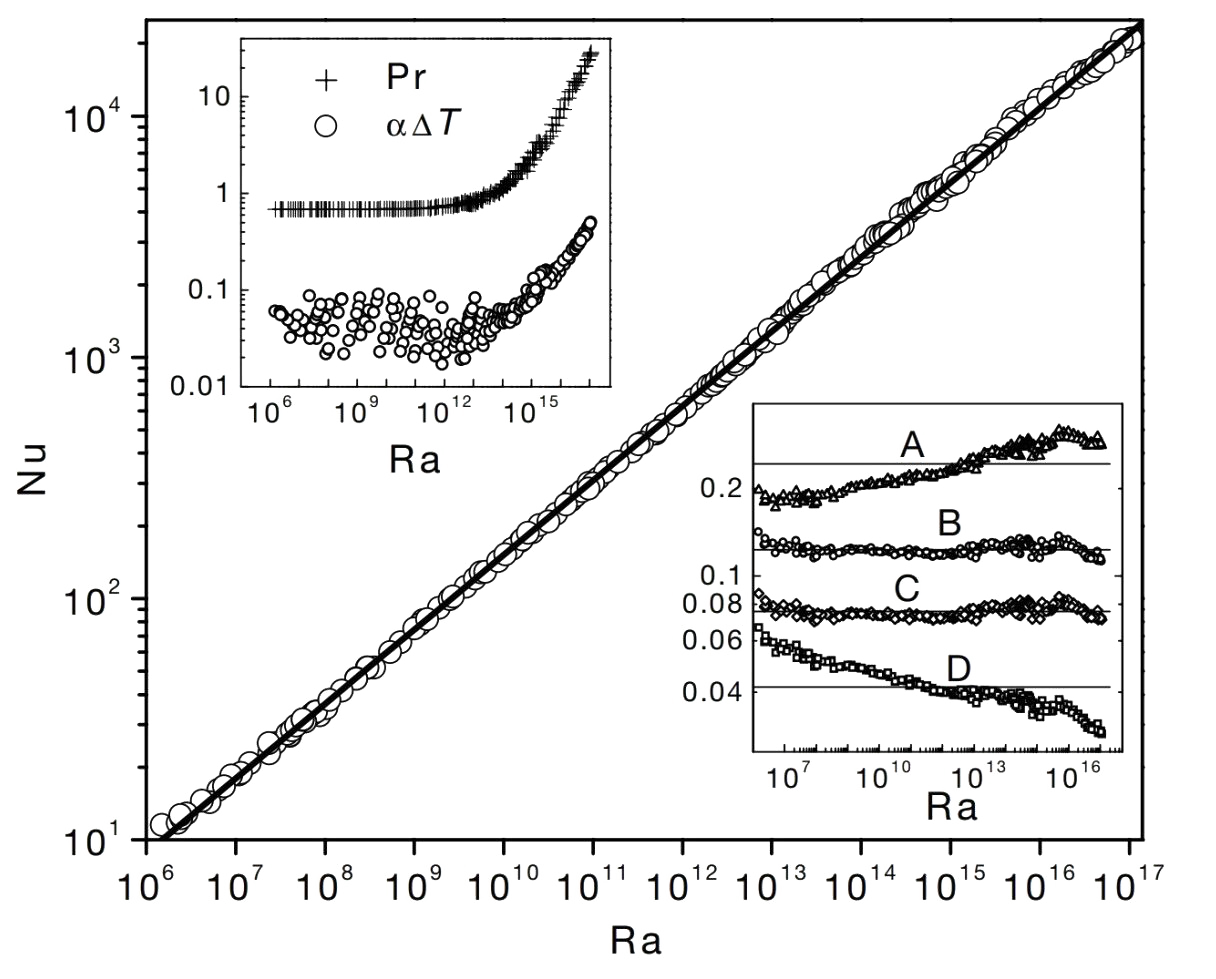
The power law observed ( \(\gamma \approx 0.31\) ) by the data was closest to the classical regime, given by \(\gamma=1 / 3\). To this day, \(\mathrm{Ra}=\mathcal{O}\left(10^{17}\right)\) remains the largest Rayleigh number achieved by any physical or numerical experiment to a permissible degree. Still, further experiments situated within the interim of this Ra range argue for both \(\gamma=1 / 2\) and \(\gamma=1 / 3\). Regardless, efforts to transcend the \(10^{17}\) cap on realized Ra are met with significant challenges. Physical experiments face difficulties when eclipsing intrinsic limitations of the convected fluid, often reaching a point at which non-Boussinesq effects, marked by \(\alpha \Delta T \gtrsim 0.2\), pollute the data. Additionally, high-resolution DNS of the OB equations can take between 10-20 days on a fully parallelized HPC environment just to resolve about \(100-1000\) eddy turnover times. To this end, the numerical challenge has been circumvented by Benzi and Verzicco, who decrease Pr by artificially increasing thermal fluctuations, all to achieve a modest \(\mathrm{Ra}=6 \times 10^{5}\) [2]. Substantive progress requires something orthogonal to the impressive, yet insufficient, growth of computing power. It is expected that the OB equations describing RBC can produce sharp estimates of the Nusselt-Rayleigh scaling at high Ra, but efforts in mathematical analysis have only been able to provide a weak upper bound of \(\gamma \leq 1 / 2\), thus failing to rule out any regime [4]. Until a reliable improvement upon the \(\mathrm{Ra}=\mathcal{O}\left(10^{17}\right)\) record is made, a distinct lack of evidence for realization of the asymptotic “ultimate” regime will persist [5].
The endeavor to reduce computational expense in pursuit of a power law regime exists within a scientific wild west. Some continue to lean on DNS while reducing the dynamical system to two spatial dimensions while others find success in changing the aspect ratio, \(\Gamma\), to non-unity values [7]. The extent to which spatial reduction to invariant subspaces or aspect ratio massaging affect the Nu-Ra relationship remains unclear, but results from many of these simplifications tend to fall in line with those that brute-force the full 3D problem.
References
[1] G. K. Batchelor. “Considerations of convective instability from the viewpoint of physics”. In: Supplemento del Nuovo Cimento 22 (1960). Ed. by R. N. Thomas. Proceedings of the 4th Symposium on Cosmical Gas Dynamics, Varenna, Italy, 18-30 August 1960, pp. 385-402.
[2] R. Benzi and R. Verzicco. “Numerical simulations of flow reversal in Rayleigh-Bénard convection”. In: EPL (Europhysics Letters) 81 (2008), p. 64008. DOI: 10.1209/0295-5075/81/64008.
[3] A. X. Chavanne et al. “Observation of the ultimate regime in Rayleigh-Bénard convection”. In: Physical Review Letters 79 (19 1997), pp. 3648-3651. DOI: 10.1103/PhysRevLett.79.3648.
[4] C. R. Doering and P. Constantin. “Variational bounds on energy dissipation in incompressible flows. III. Convection”. In: Phys. Rev. E 53 (6 June 1996), pp. 5957-5981. DOI: 10.1103/PhysRevE.53.5957.
[5] C. R. Doering, S. Toppaladoddi, and J. S. Wettlaufer. “Absence of Evidence for the Ultimate Regime in TwoDimensional Rayleigh-Bénard Convection”. In: Physical Review Letters 123.25 (Dec. 2019). ISSN: 1079-7114. DOI: 10.1103/physrevlett.123.259401.
[6] L. N. Howard. “Convection at high Rayleigh numbers”. In: Applied Mechanics, Proceedings of the 11th Congress of Applied Mechanics (1964). Ed. by H. Görtler, pp. 1109-1115.
[7] K. P. Iyer et al. “Classical \(1 / 3\) scaling of convection holds up to \(\mathrm{Ra}=10^{15}\)”. In: Proceedings of the National Academy of Sciences of the United States of America 117.14 (2020). Epub 2020-03-25, pp. 7594-7598. DOI: 10.1073/pnas. 1922794117.
[8] R. H. Kraichnan. “Turbulent Thermal Convection at Arbitrary Prandtl Number”. In: Physics of Fluids 5.11 (1962), pp. 1374-1389. DOI: 10.1063/1. 1706533.
[9] W. V. R. Malkus. “The heat transport and spectrum of thermal turbulence”. In: Proceedings of the Royal Society of London. Series A. Mathematical and Physical Sciences 225.1161 (1954), pp. 192-212. DOI: 10.1098/ rspa. 1954.0197.
[10] J. J. Niemela et al. “Turbulent convection at very high Rayleigh numbers”. In: Nature 404 (2000), pp. 837-840. DOI: 10. 1038/35009036.
[11] W. Nusselt. “Das Grundgesetz des Wärmeüberganges”. In: Gesundheitsingenieur 38 (1915), pp. 447-482, 490496.
[12] W. Nusselt. “Der Wärmeübergang in Rohrleitungen”. In: Mitt. Forsch. Arb. Ing. Wes. 89 (1909), pp. 17501787.
[13] C. H. B. Priestley. “Convection from a Large Horizontal Surface”. In: Australian Journal of Physics 7.1 (1954), pp. 171-201. DOI: 10.1071/PH540176.
[14] E. A. Spiegel. “A Generalization of the Mixing-Length Theory of Turbulent Convection”. In: The Astrophysical Journal 138 (1963), pp. 216-225. DOI: 10.1086/147628.